Boid Flocking
This page presents a classic boid flocking model—an archetypal Agent-Based Modeling (ABM) example showing how simple local rules can produce complex collective behavior such as flocking, swarming, or schooling. We cover the theory and origin of Boids, a Mesa 2.4 implementation, the key parameters, and a custom PyQtGraph visualization that colors dynamically detected swarms.
Theory & Origin
The Boids model was introduced by Craig W. Reynolds (1987) to simulate the lifelike motion of flocks using three simple rules applied locally by each agent (boid):
- Separation: Avoid crowding neighbors.
- Alignment: Steer towards the average heading of neighbors.
- Cohesion: Steer towards the average position (center of mass) of neighbors.
When combined with a limited perception radius, these rules yield emergent, coordinated group motion. See the Boids (Wikipedia) overview, and Mesa’s modern example Boid Flockers (Mesa 3.x).
Key Parameters
| Parameter | Meaning | Typical Effect |
|---|---|---|
population |
Number of boids (agents) in the environment. | Higher values increase density and interaction, often strengthening flock formation. |
width, height |
Continuous space size (environment bounds). | Smaller spaces raise encounter frequency; larger spaces disperse flocks. |
speed |
Preferred speed or max velocity per step. | Higher speed increases dynamism; may require higher vision/separation to remain stable. |
vision |
Perception radius (how far a boid senses neighbors). | Too small → fragmented motion; too large → over-synchronization or “traffic jams”. |
separation |
Repulsion distance / weight to prevent crowding. | Higher values spread agents out; too high can fragment flocks. |
alignment_weight, cohesion_weight, separation_weight |
Weights for the three steering forces (if exposed in your model). | Balances smoothness vs. responsiveness; tuning is key for realistic flocking. |
Mesa 2.4 Implementation (Classic Server)
Below is a minimal sketch of the classic Mesa 2.x server for Boids. It uses
the legacy ModularServer + JS canvas components (pre-Solara).
If you are on Mesa 3.x+, refer to the Solara example linked above.
# server.py (Mesa 2.4 style)
from mesa.visualization.ModularVisualization import ModularServer
from SimpleContinuousModule import SimpleCanvas
from model import BoidFlockers

def boid_draw(agent):
    return {"Shape": "circle", "r": 2, "Filled": "true", "Color": "Red"}

boid_canvas = SimpleCanvas(boid_draw, 500, 500)
model_params = dict(population=100, width=100, height=100, speed=5, vision=10, separation=2)

server = ModularServer(BoidFlockers, [boid_canvas], "Boid Flockers", model_params)

# run.py
from server import server
server.launch(open_browser=True)
For Mesa ≥ 3.x, visualization is Solara-based; porting is required (no JS injection). See: Mesa 3.x Boid Flockers.
Custom Visualization (PyQtGraph)
To avoid browser dependencies and gain speed, we use a PyQtGraph viewer.
It steps the model via a QTimer, draws boids as a scatter, and adds
dynamic swarm coloring based on proximity (clusters are recolored each frame).
# run_pyqt.py (launcher)
import sys
from PyQt6 import QtWidgets
from view_pyqt import BoidQtViewer
from model import BoidFlockers

params = dict(population=100, width=100, height=100, speed=5, vision=10, separation=2)
model = BoidFlockers(**params)

app = QtWidgets.QApplication(sys.argv)
viewer = BoidQtViewer(model=model, fps=30, point_size=8.0, swarm_radius=6.0)
viewer.show()
sys.exit(app.exec())
# view_pyqt.py (core viewer: dynamic clustering + coloring)
from PyQt6 import QtCore, QtWidgets
import pyqtgraph as pg
import numpy as np
import random

class BoidQtViewer(QtWidgets.QMainWindow):
    def __init__(self, model, fps=30, point_size=6.0, swarm_radius=5.0, parent=None):
        super().__init__(parent)
        self.model = model
        self.ms_per_frame = int(1000 / max(1, fps))
        self.swarm_radius = swarm_radius

        self.setWindowTitle("Boid Flockers — PyQtGraph (Dynamic Swarm Coloring)")
        self.resize(1000, 800)

        self.canvas = pg.GraphicsLayoutWidget(show=True)
        self.setCentralWidget(self.canvas)
        self.plot = self.canvas.addPlot()
        self.plot.setAspectLocked(True)
        self.plot.showGrid(x=True, y=True, alpha=0.3)

        sxmin = getattr(self.model.space, "x_min", 0.0)
        sxmax = getattr(self.model.space, "x_max", 100.0)
        symin = getattr(self.model.space, "y_min", 0.0)
        symax = getattr(self.model.space, "y_max", 100.0)
        self.plot.setXRange(sxmin, sxmax)
        self.plot.setYRange(symin, symax)

        self.scatter = pg.ScatterPlotItem(pxMode=False, size=point_size, name="Agents")
        self.plot.addItem(self.scatter)

        self.timer = QtCore.QTimer(self)
        self.timer.timeout.connect(self._step_and_render)
        self.timer.start(self.ms_per_frame)

    def _detect_swarms(self, positions, radius=5.0):
        N = len(positions)
        labels = np.full(N, -1, dtype=int)
        cluster_id = 0
        for i in range(N):
            if labels[i] != -1:
                continue
            labels[i] = cluster_id
            stack = [i]
            while stack:
                j = stack.pop()
                dists = np.linalg.norm(positions[j] - positions, axis=1)
                neighbors = np.where((labels == -1) & (dists < radius))[0]
                labels[neighbors] = cluster_id
                stack.extend(neighbors)
            cluster_id += 1
        return labels

    def _make_group_colors(self, n_groups):
        random.seed(42)
        return [(random.randint(50,255), random.randint(50,255), random.randint(50,255))
                for _ in range(n_groups)]

    def _step_and_render(self):
        self.model.step()
        agents = list(getattr(self.model.schedule, "agents", []))
        if not agents:
            return

        positions = np.array([a.pos for a in agents])
        xs, ys = positions[:,0], positions[:,1]

        labels = self._detect_swarms(positions, radius=self.swarm_radius)
        n_clusters = len(np.unique(labels))
        colors = self._make_group_colors(n_clusters)
        brushes = [pg.mkBrush(colors[l % n_clusters]) for l in labels]
        self.scatter.setData(xs, ys, brush=brushes)
Demo Clip
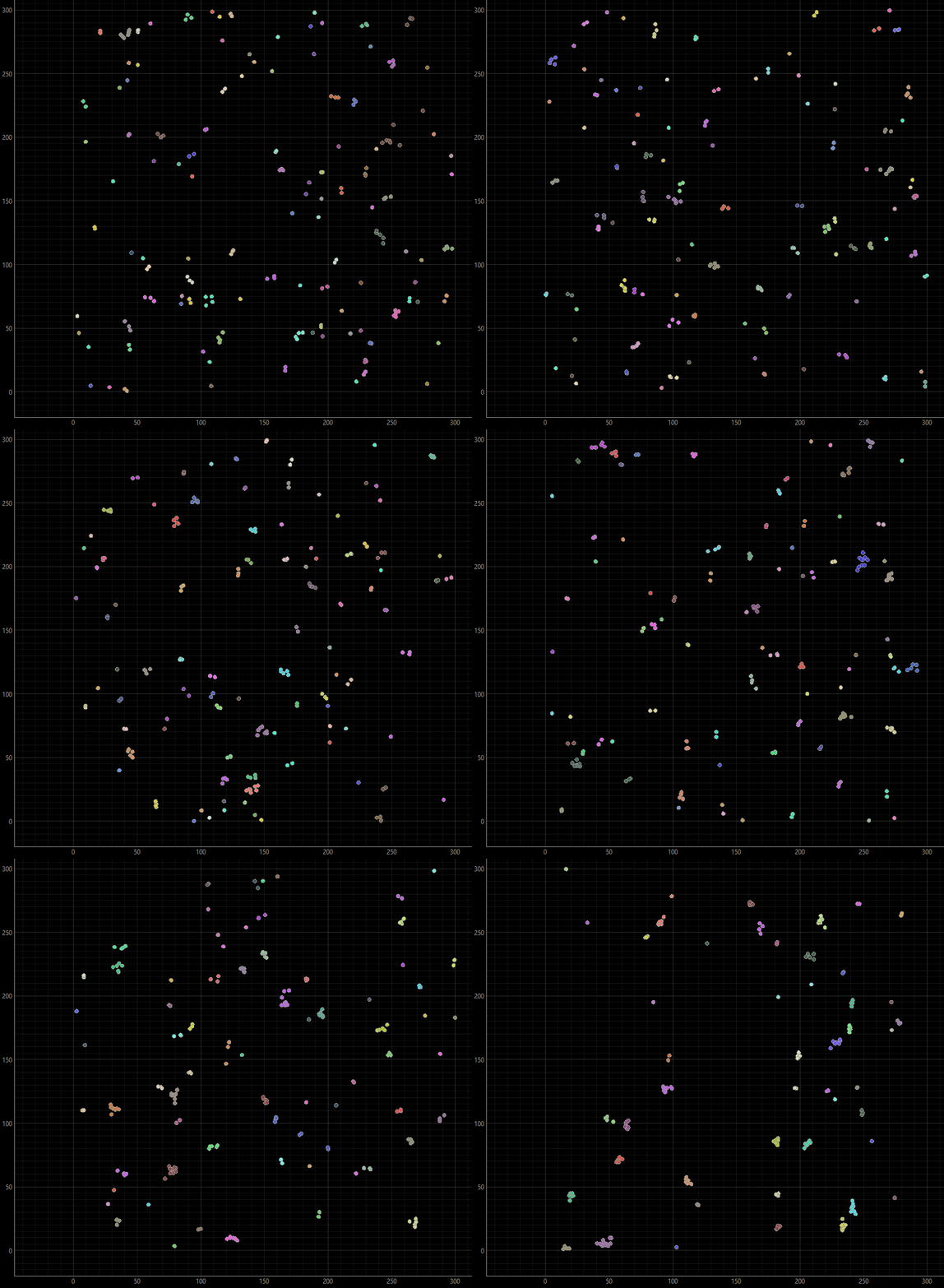 Figure: Boids simulated in Mesa with dynamic swarm coloring using a proximity-based clusterer (Population = 300.0, speed = 3.0, vision = 10.0, radius = 6.0, seperation = 1.0). Over time, the boids self-organize into distinct flocks (swarms) that move cohesively across the environment..
Download / View Source
The full source code of this demo is available on GitHub: 📥 Download / View Source
Further Reading
Craig W. Reynolds (1987). “Flocks, Herds, and Schools: A Distributed Behavioral Model.” SIGGRAPH ’87, 21(4), 25–34. (Wikipedia summary)
Mesa 3.x Boid Flockers: https://mesa.readthedocs.io/stable/examples/basic/boid_flockers.html
Mesa (Framework): https://mesa.readthedocs.io/en/stable/